Hip Replacement Surgery In Patna

Home > Hip Replacement

What is Hip Replacement Surgery?

Hip Replacement Surgery, also known as hip arthroplasty, is a highly effective surgical procedure aimed at relieving pain and restoring function in severely diseased hip joints.

The procedure involves removing the damaged femoral head (the "ball" of the thighbone) and replacing it with a prosthetic stem and ball, while the damaged cartilage of the acetabulum (the hip socket) is removed and replaced with a metal socket.
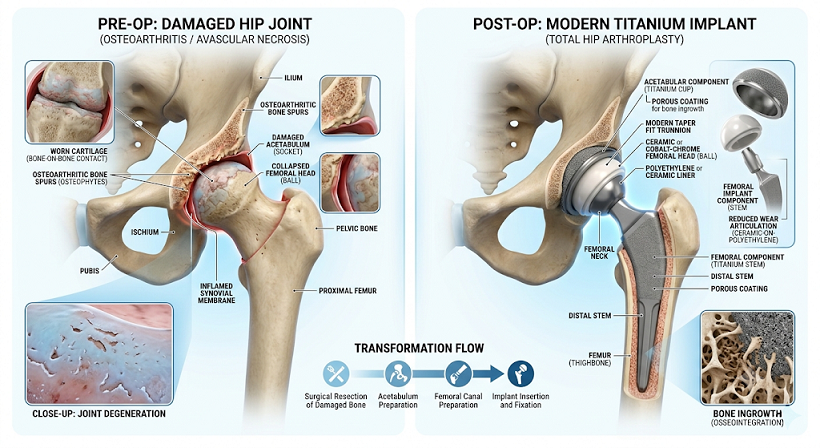
Hip Anatomy

Symptoms of Hip Replacement Surgery

  • Severe groin or thigh pain worsening during walking, bending, or bearing weight
  • Chronic hip stiffness making putting on shoes or socks difficult
  • Disturbed sleep from persistent hip aching when lying down
  • Limping gait & leg length inequality from severe joint destruction
  • Grinding or locking sensation inside the hip socket

Causes of Hip Replacement Surgery

  • Advanced Hip Osteoarthritis: Degeneration of hip ball-and-socket cartilage.
  • Avascular Necrosis (AVN): Blood supply disruption causing femoral head collapse.
  • Rheumatoid & Inflammatory Arthritis: Autoimmune erosion of hip joint surfaces.
  • Post-Traumatic Fractures: Femoral neck fractures or acetabular trauma.
Hip Pain

Who Needs Hip Replacement?

Hip Replacement Surgery is recommended when joint damage significantly impairs mobility and quality of life:

  • Severe Groin & Hip Pain Pain that limits walking, climbing stairs, or getting up from chairs.
  • Avascular Necrosis (AVN) Femoral head bone tissue death causing collapse of the ball joint.
  • Advanced Joint Stiffness Loss of hip rotation and flexibility preventing basic self-care activities.
  • Failed Non-Surgical Treatments Persistent pain despite pain medications, physical therapy, or joint injections.
CTA Background

Ready to get started?

Schedule a consultation with our orthopedic specialists today for a personalized assessment.

Diagnosis of Hip Replacement Surgery

Detailed diagnostic imaging measures bone quality, joint space loss, and anatomical alignment.

Pelvis & Hip Radiographs (X-Rays)
Hip MRI (Early AVN Detection)
3D CT Scan (Pre-Operative Implant Planning)
Leg Length Discrepancy Assessment
Comprehensive Clinical Mobility & Gait Analysis

Treatment Options for Hip Replacement Surgery

Advanced surgical techniques replace worn ball-and-socket components with biocompatible implants:

Total Hip Replacement - THR (Replacing both acetabular socket and femoral head with ceramic/metal components)
Partial Hip Replacement / Hemiarthroplasty (Replacing only the femoral ball, ideal for elderly femoral neck fractures)
Direct Anterior Approach (Muscle-sparing technique allowing faster postoperative recovery)
Robotic-Assisted Hip Arthroplasty (Computer-guided precision implant positioning to prevent leg length disparity)

Types of Hip Replacement Surgery

Total Hip Replacement (THR)

Resurfacing both the socket and femoral head with ceramic-on-polyethylene implants.

Partial Hip Replacement

Replacing only the femoral ball while preserving the natural hip socket cartilage.

Minimally Invasive Hip Arthroplasty

Muscle-sparing surgical techniques minimizing blood loss and hospital stay.

Robotic-Assisted THR

3D navigation-guided implant orientation ensuring optimal alignment and longevity.

Technology & Equipment Used in Hip Replacement Surgery

Robotic Assistance

Computer Navigation

Digital X-ray

Modern Implants

Hip Replacement Surgery

A precise and personalized approach for better outcomes and faster recovery.

1

Admission

Pre-treatment evaluation, tests and hospital admission.

2

Anaesthesia

You will be given spinal or general anaesthesia to ensure a pain-free Treatment.

3

Treatment

Damaged bone and cartilage are carefully removed to prepare the joint.

4

Implant

Artificial joint (prosthesis) is precisely positioned and the hip is realigned.

Benefits / Advantages of Hip Replacement Surgery

Pain Relief

Dramatic relief from chronic hip pain.

Better Walking

Enhances function and stabilizes the hip.

Improved Mobility

Regain full range of motion.

Better Quality of Life

Return to a positive, active lifestyle.

Potential Risks of Hip Replacement Surgery

Infection

Blood Clot

Implant Wear

Nerve Injury

Recovery Timeline for Hip Replacement Surgery

Week 1
Hospital stay, initial physiotherapy, and walking with a walker.
Week 2
Stitches removed, transitioning to a cane, continued exercises.
1 Month
Walking independently, returning to light activities and driving.
3 Months
Significant improvement in strength and flexibility. Most daily activities resumed.
6 Months
Full recovery achieved. Hip feels natural.

Physiotherapy After Hip Replacement Surgery

Physical therapy is crucial for a successful recovery, helping restore strength and range of motion.

Exercises
Walking
Strengthening
Home Care
Physiotherapy

Cost of Hip Replacement in Patna

The exact cost of hip replacement surgery varies from patient to patient. We provide transparent pricing customized to your specific medical needs.

Factors Affecting Cost

Type of implant used, surgical technique (Robotic vs. Manual), and hospital stay duration.

Insurance Support

We accept all major health insurance policies and TPA networks for your convenience.

Cashless Treatment

Cashless facilities are available under Ayushman Bharat and selected corporate insurance plans.

Why Choose Dr. Abhijeet Jayaswal?

MBBS, M.S.(Ortho), DNB (Ortho) 10+ Years Experience Popular Orthopaedic Hospital
  • Fellowship Training: Completed prestigious fellowships in sports medicine, hip, and shoulder arthroscopy from Deenanath Mangeshkar Hospital, Pune.
  • Clinical Experience: Over 10+ years of clinical experience, combining advanced training with a patient-centric approach to deliver exceptional orthopedic care.
  • Patient-Centered Care: Dedicated to delivering personalized and effective care tailored to each patient's unique needs with meticulous attention to detail.
  • Advanced Technology: Focused on the latest advancements in orthopaedics to ensure the best possible outcomes and cutting-edge treatment options.
Dr. Abhijeet Jayaswal

Frequently Asked Questions