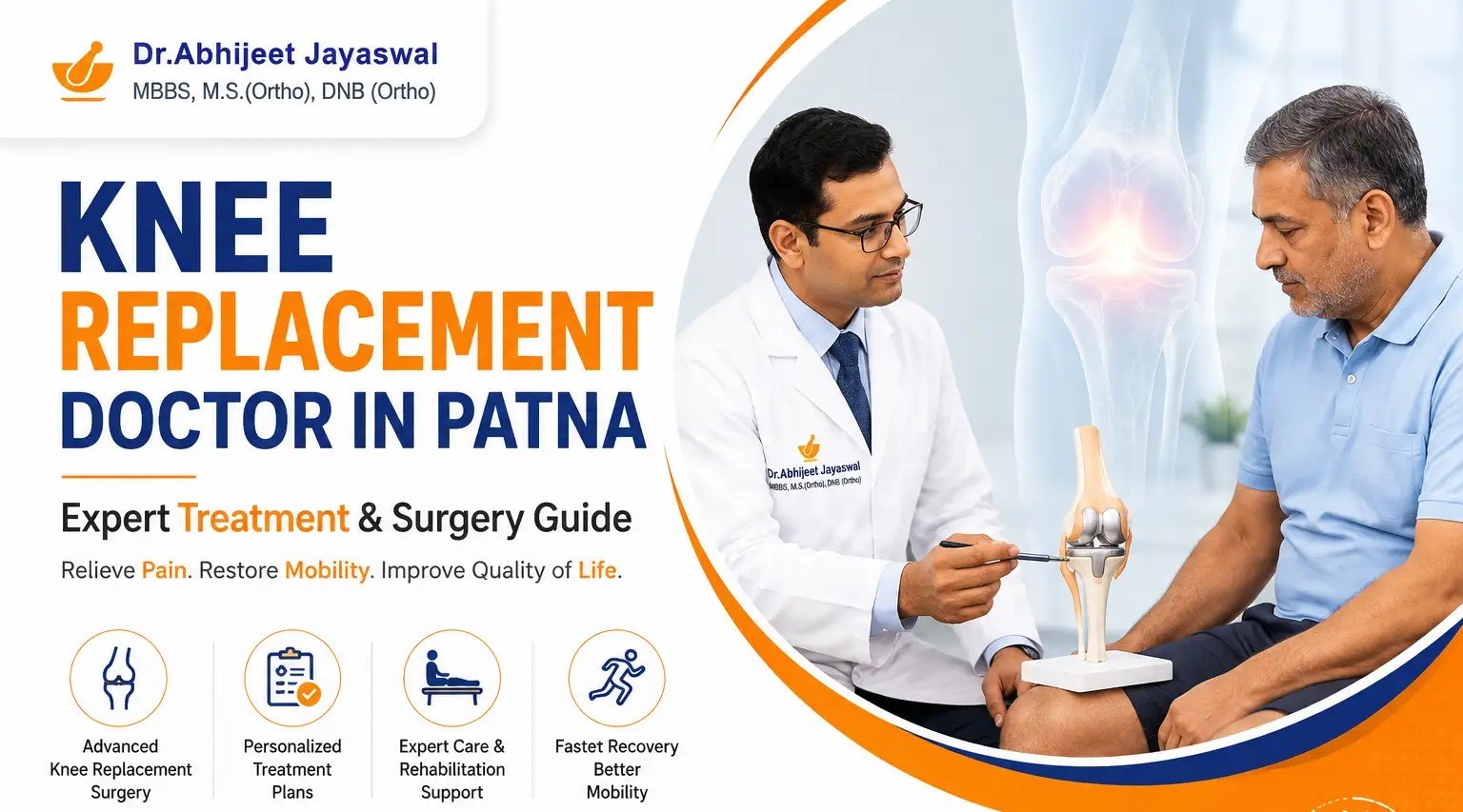
Persistent knee pain can make walking, climbing stairs, sitting, standing, exercising, and performing everyday activities difficult. While many knee problems can improve with medicines, physiotherapy, exercise, and lifestyle changes, advanced arthritis and severe joint damage may require evaluation by an orthopedic specialist.
If you are searching for a knee replacement doctor in Patna, it is important to understand when knee replacement may be considered, what treatment options are available, and what recovery may involve. Dr. Abhijeet Jayaswal provides orthopedic and joint replacement care in Patna, with knee replacement included among his listed orthopedic treatments.
When Should You See a Knee Replacement Doctor in Patna?
Not every patient with knee pain needs knee replacement surgery. The first step is identifying the underlying cause of the pain and determining whether the condition can be managed with non-surgical treatment.
You should consider an orthopedic consultation if knee pain is persistent, affects your mobility, interferes with sleep, or makes normal activities such as walking and climbing stairs difficult.
- Persistent or worsening knee pain
- Stiffness and reduced range of motion
- Difficulty walking or standing for long periods
- Pain while climbing or descending stairs
- Difficulty getting up from a chair
- Knee swelling or inflammation
- Progressive knee deformity
- Pain that continues despite conservative treatment
The Indian Council of Medical Research (ICMR) Standard Treatment Workflow for Osteoarthritis of the Knee describes symptoms, investigations, conservative treatment, and circumstances in which total knee replacement may be considered.
What Causes Severe Knee Pain?
Knee pain can have several causes. Osteoarthritis is one of the common conditions associated with progressive cartilage and joint damage. Other causes may include previous injuries, inflammatory arthritis, ligament problems, meniscus injuries, or structural abnormalities.
A proper orthopedic evaluation is important because treatment should be based on the actual cause and severity of the knee problem rather than pain alone.

When Is Knee Replacement Surgery Recommended?
Knee replacement may be considered when advanced arthritis or other significant joint damage causes persistent pain and loss of function, particularly when appropriate non-surgical treatments have not provided sufficient relief.
According to the ICMR Standard Treatment Workflow, patients with advanced knee osteoarthritis may require surgery when severe pain or stiffness limits activities of daily living, walking becomes significantly difficult, pain persists at rest or at night, or severe deformity is present after appropriate conservative treatment has failed.
However, knee replacement is not automatically required simply because an X-ray shows arthritis. The decision should be based on symptoms, examination findings, imaging, overall health, functional limitations, and response to previous treatment.
What Is Knee Replacement Surgery?
Knee replacement surgery is a procedure in which damaged surfaces of the knee joint are replaced with artificial components. The objective is to reduce pain, improve mobility, and restore useful knee function in appropriately selected patients.
Depending on the extent of joint damage, an orthopedic surgeon may consider total or partial knee replacement. The appropriate procedure is determined after a detailed clinical assessment.
Types of Knee Replacement
Total Knee Replacement
Total knee replacement involves replacing the damaged surfaces of the knee joint with artificial components. It may be considered when arthritis or joint damage affects multiple areas of the knee.
Partial Knee Replacement
Partial knee replacement may be considered when significant arthritis is limited to one compartment of the knee and the remaining parts of the joint are suitable for preservation.
The choice between total and partial knee replacement depends on the patient's condition, joint damage, ligament status, activity level, medical history, and orthopedic assessment.
Benefits of Knee Replacement Surgery
For appropriately selected patients, knee replacement surgery may provide meaningful improvements in pain and mobility.
- Reduction in chronic knee pain
- Improved walking ability
- Improved knee function
- Greater ability to perform daily activities
- Improved mobility and independence
- Better quality of life
Individual results vary. Recovery and long-term outcomes depend on several factors, including overall health, the extent of joint damage, the surgical procedure, rehabilitation, and adherence to postoperative instructions.
How to Choose a Knee Replacement Doctor in Patna
Choosing a knee replacement surgeon should involve more than searching for the phrase "best knee replacement doctor." Patients should consider relevant orthopedic qualifications, joint replacement training, clinical experience, hospital facilities, surgical planning, rehabilitation support, and postoperative follow-up.
Dr. Abhijeet Jayaswal's official profile lists MBBS, M.S. (Ortho), and DNB (Ortho) qualifications, along with fellowship training in arthroplasty at Nanavati Hospital, Mumbai. His website also states that he has more than 10 years of orthopedic experience.
You can view Dr. Abhijeet Jayaswal's orthopedic profile and qualifications before scheduling a consultation.
Knee Replacement Treatment in Patna
Dr. Abhijeet Jayaswal provides orthopedic and joint replacement care in Patna. His treatment profile includes joint replacement, knee replacement, hip replacement, shoulder replacement, arthroscopy, sports medicine, fracture and trauma care, spine care, arthritis treatment, and pain management.
You can explore the complete range of orthopedic treatments available in Patna on the official website.
Knee Replacement Recovery
Recovery after knee replacement varies from patient to patient. Age, general health, the surgical procedure, muscle strength, rehabilitation, and other medical factors can influence recovery.
Rehabilitation may include physiotherapy, walking exercises, gradual improvement in knee movement, pain management, and scheduled follow-up appointments. Patients should follow the personalized rehabilitation plan provided by their orthopedic team.
If rehabilitation support is required, you can also learn more about orthopedic rehabilitation in Patna .
Is Knee Replacement the Only Treatment for Knee Pain?
No. Knee replacement is not the only treatment option for knee pain. Depending on the diagnosis and severity, treatment may include exercise, physiotherapy, medicines, weight management, injections, activity modification, joint-preserving procedures, or other orthopedic treatments.
This is why an accurate diagnosis is important before deciding on surgery. A qualified orthopedic specialist can help determine whether conservative treatment or surgery is appropriate for your condition.
Persistent knee pain should not be ignored, especially when it begins affecting walking, sleep, work, or everyday activities. Knee replacement can be an effective treatment for appropriately selected patients with advanced joint damage, but surgery should be considered only after a detailed orthopedic evaluation.
If you are searching for a knee replacement doctor in Patna, consider the surgeon's qualifications, relevant joint replacement training, experience, treatment approach, hospital facilities, and postoperative rehabilitation support. Dr. Abhijeet Jayaswal provides orthopedic and joint replacement care in Patna and can evaluate your condition and discuss appropriate treatment options.
Schedule an orthopedic consultation in Patna to discuss your knee pain and treatment options.
Frequently Asked Questions
Knee replacement may be recommended when severe knee pain, stiffness, joint damage, or difficulty in daily activities continues despite appropriate non-surgical treatment.
Recovery varies from patient to patient. Many patients gradually return to light daily activities within a few weeks, while full recovery and rehabilitation can take several months.
Knee replacement surgery may help reduce chronic knee pain, improve mobility, restore knee function, and make everyday activities easier for appropriately selected patients.
No. Knee replacement is not suitable for everyone with knee pain. An orthopedic evaluation is needed to determine the cause of pain and the most appropriate treatment.
Treatment depends on the underlying condition and may include physiotherapy, medication, exercise, lifestyle changes, injections, joint-preserving procedures, or knee replacement surgery when clinically appropriate.
You can contact Dr. Abhijeet Jayaswal through his official website to discuss your knee condition, treatment options, and whether knee replacement may be appropriate for you.
Related Treatments & Services
Ready to get started?
Schedule a consultation with our orthopedic specialists today for a personalized assessment.